
How to Build an Airbnb Investment Strategy: A Step-by-Step Guide for 2026

Editorial & Financial Disclaimer
This article is educational and does not constitute financial, tax, or investment advice. All figures are illustrative. The case study is hypothetical and does not represent an actual Roam property, client outcome, or guaranteed return. Regulatory information should be verified with current city and state sources before acting.
Most people don't lose money on Airbnb because the model is broken. They lose money because they buy a house first and figure out the strategy later. A real airbnb investment strategy reverses that order: goals, then market, then neighborhood, then property, then numbers — and only then, a purchase.
Quick Answer
Building an Airbnb investment strategy means working through a defined sequence before you ever make an offer: define your goals, select a market, identify demand drivers, establish property criteria, underwrite the deal, model financing and total cash invested, compare STR against MTR and LTR, plan furnishing and guest experience, choose a management strategy, stress-test the numbers, decide whether to buy, and build toward a portfolio. Skipping any step turns an investment into a bet.
The twelve moves, in order:
- Define investment goals
- Select a market
- Identify demand drivers
- Establish property criteria
- Underwrite the deal
- Model financing and total cash invested
- Compare STR, MTR and LTR
- Plan furnishing and guest experience
- Determine management strategy
- Stress-test the deal
- Decide whether to buy
- Build and scale the portfolio
Table of Contents
- What Is an Airbnb Investment Strategy?
- Step 1: Define Your Investment Goals
- Step 2: Choose the Right Airbnb Market
- Step 3: Identify the Right Neighborhood and Micro-Market
- Step 4: Create Your Airbnb Property Buy Box
- Step 5: Underwrite the Airbnb Before You Buy
- Step 6: Stress-Test the Investment
- Step 7: STR vs MTR vs LTR
- Step 8: Build the Property Around the Target Guest
- Step 9: Choose a Management Strategy
- Step 10: Calculate Your Maximum Purchase Price
- Step 11: Know When to Walk Away
- Step 12: Build a Repeatable Airbnb Portfolio Strategy
- Airbnb Investment Strategy in Phoenix and Scottsdale
- The Roam Airbnb Investment Strategy Framework
- Hypothetical Case Study
- Frequently Asked Questions
What Is an Airbnb Investment Strategy?
An Airbnb investment strategy is a repeatable, written framework for deciding which markets, properties, and operating models will meet a specific financial goal — as opposed to buying a house and hoping the short-term rental math works out afterward. It connects goals, market research, underwriting, and operations into one decision process you can apply to every deal.
A few terms get used interchangeably in this space, and precision matters:
| Term | What It Means |
|---|---|
| Investment strategy | The full framework: goals, markets, property criteria, financing, risk tolerance, and portfolio plan |
| Investment thesis | The specific reasoning for why this property, in this market, meets your goal (e.g., "cash flow from a mid-size home near a hospital campus in a low-regulation submarket") |
| Buy box | The concrete, numeric filter you use to screen properties — price range, bed count, lot size, STR legality, etc. |
| Underwriting | The financial modeling of a specific deal: projected revenue, expenses, debt service, and returns |
| Operating strategy | How the property will actually run day to day — self-managed, co-hosted, or professionally managed |
| Portfolio strategy | How one property becomes several, and how capital, markets, and property types are diversified over time |
The difference between buying an Airbnb and building an investment strategy is the difference between a single decision and a decision-making system. Anyone can buy a house near a lake and list it. An investor with a strategy can look at ten deals, reject eight of them for specific, articulable reasons, and know exactly why the two remaining deals meet their return target before an offer is written.
Step 1: Define Your Investment Goals
How do I create an Airbnb investment strategy? Start by defining the outcome you actually want, because "cash flow now" and "equity growth over ten years" lead to different markets, different property types, and different underwriting thresholds.
Common goal categories investors weigh:
- Cash flow — consistent monthly income above debt service and expenses, prioritized over appreciation
- Appreciation — buying in a market with strong long-term price growth even if near-term cash flow is thin
- Passive income — income that requires minimal hands-on time, which usually points toward full-service management
- Portfolio growth — using each property's equity and cash flow to fund the next acquisition
- Diversification — spreading capital across markets, property types, or rental strategies to reduce single-asset risk
- Long-term wealth building — combining cash flow, appreciation, debt paydown, and tax treatment over a multi-year hold
Tax treatment is a real part of Airbnb investing — depreciation, cost segregation, and the mechanics of "material participation" can meaningfully change after-tax returns for short-term rentals specifically. This is genuinely useful territory to understand, but it is also easy to get wrong. Talk to a CPA or tax attorney familiar with short-term rental rules before you build a strategy around a specific tax outcome; nothing here should be treated as tax advice.
Write your goal down as a number, not a feeling. "I want passive income" is not actionable. "I want $1,500/month in net cash flow with under 10 hours/month of my own time" is a filter you can underwrite against.
Step 2: Choose the Right Airbnb Market
What are the best Airbnb investment markets in 2026? There is no single best market — the right one depends on your goal, your capital, and your risk tolerance — but every strong market shares the same underlying traits: durable demand, a workable regulatory environment, and an acquisition price that still leaves room for a return after real expenses.
Market selection has to happen before property selection, not after, because a great house in a saturated, over-regulated, or demand-poor market will underperform a mediocre house in a strong one. Evaluate a market on:
- Demand fundamentals — tourism, business travel, medical travel, university traffic, events, seasonal patterns
- Rate and occupancy data — ADR, occupancy rate, and RevPAR (ADR × occupancy) from a licensed data provider
- Seasonality — how much revenue swings between the best and worst months, and whether you can absorb the trough
- Regulatory environment — whether the city licenses, permits, caps, or restricts short-term rentals, and how enforcement actually works
- Acquisition cost relative to revenue — price-to-revenue ratios, not just sticker price
- Competition and supply growth — whether listing counts are growing faster than demand
- Infrastructure and access — airport proximity, highway access, walkability to draws
- Employers, universities, and anchor institutions — sources of recurring, non-leisure demand
Why Market Selection Comes First
Two identical houses, priced identically, can produce dramatically different returns purely based on the market underneath them. A house in a market with strong shoulder-season demand and a workable permit process can carry a mortgage comfortably at 55% occupancy. The same house in a saturated, high-regulation market might need 70%+ occupancy to break even — and that is before you've evaluated the property itself. Get the market decision right, and the property decision gets easier. Get it wrong, and no buy box fixes it.
Step 3: Identify the Right Neighborhood and Micro-Market
City-level averages hide the variation that actually determines a property's performance. A metro-wide occupancy figure blends downtown corporate-travel condos with far-suburban houses that see almost no bookings — averaging them together tells you very little about either one.
Evaluate the micro-market on:
- Proximity to demand drivers — the specific hospital, stadium, convention center, ski hill, or business district guests are actually traveling for
- Guest travel time — minutes from the airport, downtown, or the primary attraction, not just miles
- Neighborhood appeal — walkability, dining, safety perception, and the "would I want to stay here" test
- Competing listings — supply density and how differentiated your property would be
- Accessibility and parking — a genuine friction point for STR guests, especially groups
- Objective safety information — publicly available crime data, not word of mouth
- Local regulations at the sub-city level — some cities zone STRs differently block by block or by HOA overlay
- Price-to-revenue relationship — whether the entry price in this specific pocket is justified by realistic achievable revenue
A useful habit: pull revenue and occupancy data at the neighborhood level, not just the city level, before you get attached to a specific listing.
Step 4: Create Your Airbnb Property Buy Box
What should I look for in an Airbnb investment property? A buy box is the checklist that lets you screen twenty listings in an afternoon instead of falling in love with the first one that looks nice in photos.
Airbnb Property Buy Box
| Criterion | Target/Range | Why It Matters |
|---|---|---|
| Purchase price | Depends on market and goal | Sets the debt-service and cash-invested baseline for every return metric |
| Bedrooms/bathrooms | Match target guest group size | Drives ADR ceiling and guest-capacity revenue potential |
| Square footage | Depends on market | Affects furnishing cost, guest capacity, and comp-set positioning |
| Parking | On-site preferred where market allows | Removes a common guest friction point and 1-star review trigger |
| Outdoor space | Pool, patio, or yard where market rewards it | Differentiates listing and supports premium ADR in warm-weather markets |
| Layout | Open, flexible sleeping arrangements | Increases usable guest capacity without added bedrooms |
| Amenities | Depends on target guest and comp set | Directly affects booking conversion and review scores |
| Renovation needs | Minimal to moderate, cost-quantified before offer | Unbudgeted rehab is the single most common source of underwriting error |
| Guest capacity | Matched to target market segment | Determines achievable ADR tier |
| Property taxes | Verify actual current assessment | Frequently underestimated in pro formas |
| Insurance | STR-specific policy quoted, not assumed | Standard homeowner's policies often exclude short-term rental use |
| HOA restrictions | Confirm STR use is explicitly permitted | An HOA can prohibit STRs even where the city allows them |
| STR legality | Confirm zoning and licensing before offer, not after close | The single biggest deal-killer if missed |
| Financing constraints | Confirm loan program allows non-owner-occupied STR use | Some loan products restrict short-term rental use explicitly |
Treat "depends on market" as an honest answer, not a dodge — a buy box built for a mountain-town cabin market looks nothing like one built for an urban medical-travel condo market, and pretending otherwise produces bad screens.
Step 5: Underwrite the Airbnb Before You Buy
How do I calculate Airbnb ROI? Underwriting is where an Airbnb investment strategy either holds up or falls apart — this is the step that separates a real investment decision from a purchase based on vibes.
The Core Formulas
Core Formulas
Gross Revenue = ADR × Occupied Nights

NOI (Net Operating Income) = Gross Revenue − Operating Expenses

Cash Flow = NOI − Debt Service

Cash-on-Cash Return = Annual Pre-Tax Cash Flow ÷ Total Cash Invested

Total Cash Invested = Down Payment + Closing Costs + Furnishing +
                     Setup + Initial Reserves + Other Acquisition Costs
These formulas are educational frameworks, not guarantees of any specific outcome — actual performance depends on market conditions, execution, and factors outside any model's control.
What Belongs in Operating Expenses
A common underwriting mistake is modeling only mortgage, taxes, and insurance and forgetting the line items that are unique to short-term rental operations:
- Property management or self-management labor cost
- Cleaning fees between stays (often guest-reimbursed, but reconcile net impact)
- Utilities (typically owner-paid in STR, unlike most long-term rentals)
- Platform fees (Airbnb, Vrbo, and any booking-channel commissions)
- Supplies and consumables (linens, toiletries, coffee, replacement items)
- Maintenance and repairs reserve
- STR-specific insurance premium
- Furnishing depreciation or a replacement reserve
- Permit, license, and compliance costs
- Applicable transient lodging and transaction privilege taxes (these are typically collected from guests and remitted, but still belong in your compliance model)
Break-Even Occupancy and Payback Period
What is the break-even occupancy rate for an Airbnb? Break-even occupancy is the number of booked nights, as a percentage of available nights, at which gross revenue exactly covers operating expenses and debt service — below that line, the property is running a deficit regardless of how strong the ADR looks on paper. It varies by property and market, so it must be calculated per deal, never assumed from a national average.
Payback period is simply how long it takes cumulative cash flow to return your total cash invested. A shorter payback period generally signals a lower-risk deal, all else equal, because it reduces your exposure to a market downturn before you've recovered your capital.
Cash-on-Cash Return Benchmarks
What is a good Airbnb cash-on-cash return? There is no universal number that applies to every investor or market — a rate that looks strong to a cash-flow-focused investor in a stable secondary market may look weak to an investor targeting rapid capital growth in a high-appreciation market. Rather than anchoring to a generic percentage, set your own minimum threshold based on your goals from Step 1, your cost of capital, and the risk profile of the specific market, then reject any deal that doesn't clear it.
Clearly separate any illustrative example in this article from a specific Roam deal or client result — the numbers below are for teaching the framework, not a claim about actual performance.
Step 6: Stress-Test the Investment
A deal that only works in the best-case scenario is not an investable deal — it's a bet with extra steps. Before committing capital, run the underwriting through three scenarios:
| Metric | Downside | Base | Upside |
|---|---|---|---|
| Occupancy | Below-market, seasonal trough weighted | Market-consistent average | Above-market, strong execution |
| ADR | Discounted from comp set | In line with comp set | Premium pricing, strong reviews |
| Operating expenses | Higher than modeled (repairs, turnover) | As modeled | Lower than modeled (efficient ops) |
| Ramp-up period | Extended (permitting delays, slow reviews) | As planned | Faster than expected |
| Interest rate/financing cost | Higher than locked rate assumption | As locked | N/A — largely fixed once closed |
Stress the variables that are most likely to move against you specifically: occupancy and ADR in a softening market, repair costs in an older property, ramp-up time in a market with slow permit turnaround, and furnishing overruns if you're doing a full design build-out. If the downside case still services debt and covers expenses — even without profit — that's a meaningfully more resilient deal than one that only cash-flows when everything goes right.
Step 7: STR vs MTR vs LTR
Is Airbnb better than a long-term rental? Neither model is universally superior — short-term, mid-term, and long-term rentals each trade revenue potential against operational intensity and risk exposure differently, and the right choice depends on the specific property, market, and your management capacity.
STR vs MTR vs LTR
| Factor | STR (Short-Term) | MTR (Mid-Term) | LTR (Long-Term) |
|---|---|---|---|
| Revenue potential | Highest ceiling, most variable | Moderate, more predictable than STR | Lowest ceiling, most predictable |
| Operational intensity | High (turnovers, guest communication, pricing) | Moderate (monthly turnovers, less daily management) | Low (annual or multi-year leases) |
| Seasonality exposure | High in leisure/tourism markets | Lower — often insured/relocation/travel-nurse demand | Minimal |
| Regulatory exposure | Highest — permits, licenses, occupancy taxes | Lower in most jurisdictions | Lowest |
| Furnishing requirement | Full furnish-and-decorate required | Furnished, simpler than STR-grade | Typically unfurnished |
| Flexibility | High — can adjust pricing nightly | Moderate — 30+ day minimum stays | Low — locked into lease terms |
| Equity creation | Depends on appreciation + paydown + cash flow | Depends on appreciation + paydown + cash flow | Depends on appreciation + paydown + cash flow |
| Management requirements | Highest, or highest cost if outsourced | Moderate | Lowest |
| Risk profile | Highest revenue variance | Balanced | Lowest revenue variance |
Some investors run a hybrid model — treating a property as STR in peak season and shifting to mid-term or extended stays in the off-season — to smooth seasonality in markets with a pronounced trough. That approach adds operational complexity in exchange for revenue stability, and it's worth underwriting explicitly rather than assuming it will "just work."
Step 8: Build the Property Around the Target Guest
A property built for a generic guest underperforms a property built for a specific one. Before finalizing design and furnishing decisions, define:
- Target guest — family leisure travelers, business travelers, medical travelers, event attendees, remote workers
- Travel purpose — vacation, work, medical care, relocation, events
- Bedroom configuration — matched to typical group size for that guest type
- Workspace — a dedicated desk and reliable Wi-Fi matter disproportionately for business and remote-work guests
- Amenities — pool and outdoor space for leisure/group travelers; proximity and simplicity for medical or business travelers
- Design and photography — professional photography and a cohesive design story directly affect click-through and booking conversion
- Guest experience and reviews — check-in process, cleanliness consistency, and responsiveness compound into review velocity, which compounds into search ranking on the booking platforms themselves
Every design decision should trace back to the investment thesis. A high-end design build-out aimed at a bargain-focused guest segment is a mismatch that shows up directly in your cash-on-cash return.
Step 9: Choose a Management Strategy
Should I self-manage or hire a property manager? The right answer depends on your time availability, your proximity to the property, and how much revenue-optimization expertise you're able to apply yourself — there's no universally correct choice.
- Self-management — lowest direct cost, highest time commitment, requires local presence or a strong local vendor network for cleaning and maintenance
- Co-hosting — a hybrid where you retain some control (pricing, guest communication) while outsourcing operational tasks like cleaning and turnovers
- Full-service property management — highest direct cost as a percentage of revenue, lowest time commitment, generally includes dynamic pricing, guest communication, cleaning coordination, maintenance dispatch, and compliance tracking
Each option affects workload, pricing sophistication, guest communication speed, cleaning consistency, maintenance response time, revenue optimization, regulatory compliance tracking, and how easily the strategy scales to a second or third property. How do out-of-state investors manage Airbnb properties? Out-of-state and remote investors typically lean toward full-service management or a strong local co-host, since compliance deadlines, same-day maintenance issues, and guest emergencies are difficult to handle from a different time zone.
Roam works with investors across this spectrum — from owners who want a full-service partner to handle compliance, pricing, and guest operations, to those who want data and guidance while retaining more hands-on control. The right structure depends on your goals, your location relative to the property, and how much of the operating burden you want to carry yourself.
Step 10: Calculate Your Maximum Purchase Price
Most first-time investors ask the wrong question. They ask, "Can I afford this property?" A disciplined investor asks the reverse: "What is the maximum price this property can support while still meeting my return target?"
This is reverse underwriting, and it protects you from anchoring to a listing price and rationalizing your way into a weak deal.
Simplified framework (educational, not a guarantee of outcome):
- Start with your target cash-on-cash return (from Step 1's goals)
- Project realistic NOI for the property based on market-verified ADR and occupancy
- Determine expected financing terms (rate, down payment, amortization) based on current lending conditions
- Solve for the total cash invested that satisfies:
Target CoC Return = Annual Cash Flow ÷ Total Cash Invested - Back into the maximum acquisition price that keeps total cash invested — and the resulting debt service — within that ceiling
If the seller's asking price is above the number this framework produces, the deal doesn't meet your target at that price — full stop. The framework doesn't tell you the deal is bad; it tells you the price is wrong for your goal, which is a negotiating position, not a rejection.
Step 11: Know When to Walk Away
What are the biggest Airbnb investment mistakes? Nearly all of them trace back to skipping a step in this framework — usually underwriting or legality — under time pressure to close a deal.
Deal-Killer Checklist
| Red Flag | Why It Matters | Action |
|---|---|---|
| Illegal or uncertain STR use | Zoning, permit, or HOA restrictions can make the property unrentable as an STR | Verify in writing before writing an offer, not after close |
| Unsupported demand assumptions | Revenue projections not backed by verified market data | Pull licensed comp-set data before underwriting |
| Unrealistic occupancy assumptions | Overly optimistic occupancy inflates every downstream return metric | Use trailing market averages, not aspirational figures |
| Excessive acquisition price | Price exceeds the maximum supported by your target return | Walk away or renegotiate — don't stretch the return target instead |
| Excessive renovation scope | Underestimated rehab erodes total cash invested and payback period | Get contractor quotes before underwriting, not after |
| Insurance issues | STR-specific coverage unavailable or prohibitively expensive | Quote insurance before close, not as an afterthought |
| HOA restrictions | HOA can override a city's STR allowance entirely | Confirm HOA documents explicitly permit STR use |
| Weak layout | Poor guest flow or limited sleeping capacity caps achievable ADR | Model achievable guest capacity realistically, not aspirationally |
| Weak demand drivers | No durable reason for travel to this specific location | Confirm at least one durable, non-seasonal demand anchor |
| Oversupply | Listing growth outpacing demand growth compresses future ADR | Check supply-growth trend, not just current performance |
| Insufficient parking | Common guest friction point and review driver in car-dependent markets | Confirm on-site or nearby parking availability |
| No margin of safety | Deal only works in the upside case from Step 6 | Require the downside case to at least cover debt service |
If two or more of these apply, the discipline is to walk — even after you've spent time and money getting to the offer stage.
Step 12: Build a Repeatable Airbnb Portfolio Strategy
How do I scale from one Airbnb to multiple properties? Scaling successfully means turning your first deal's underwriting process into a repeatable system, rather than treating each new purchase as a one-off decision.
A repeatable portfolio strategy typically includes:
- Standardized buy boxes per market or property type, refined after each acquisition
- Capital allocation rules — how much of your available capital goes into any single deal
- Market diversification — spreading exposure across more than one metro or submarket to reduce single-market regulatory or demand risk
- Property-type diversification — mixing guest-capacity tiers or neighborhoods rather than replicating one exact property profile
- Reserves policy — a consistent minimum reserve per property, not just per portfolio
- Financing capacity planning — tracking debt-to-income and lender appetite before you need the next loan, not after
- Operating systems — consistent cleaning, maintenance, and guest-communication processes that don't depend entirely on your personal time
- Performance tracking — comparing actual results against underwriting on every property, every quarter
- A defined trigger for the next purchase — a specific cash reserve level or return threshold, not "whenever it feels right"
- Over-leverage guardrails — a ceiling on aggregate debt service relative to portfolio income, so one soft season doesn't threaten the whole portfolio
One property teaches you the mechanics. A second property, bought against the same disciplined framework, is what actually starts to look like a portfolio.
Airbnb Investment Strategy in Phoenix and Scottsdale
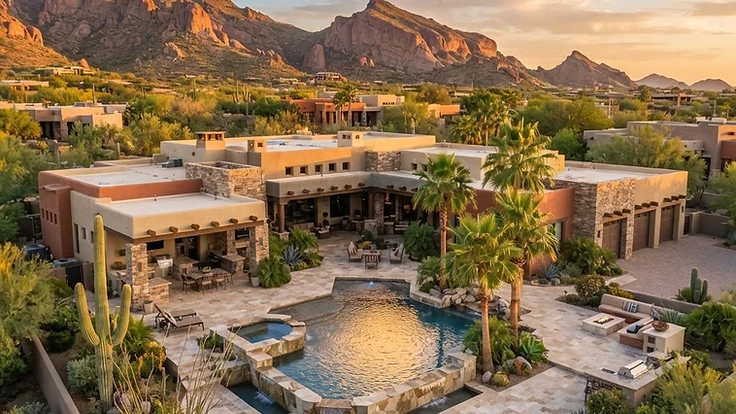
Phoenix and Scottsdale sit in the same metro area but function as genuinely different short-term rental markets, with different guest profiles, different regulatory postures, and different price-to-revenue relationships.
Phoenix vs Scottsdale: Demand and Positioning
Phoenix draws a broader, more budget-conscious and business-oriented guest base, alongside significant medical travel tied to major healthcare campuses in the metro area. Scottsdale skews toward a higher-spending leisure guest — golf, resort-style stays, and events — which typically supports a materially higher achievable ADR. Recent market data illustrates the gap clearly: one dataset put Scottsdale's average daily rate at roughly $396 with 44.4% occupancy and $179 RevPAR, against Phoenix's roughly $283 ADR, 44.1% occupancy, and $129 RevPAR — figures that will vary by data provider, property mix, and time period, and should be treated as directional rather than exact for any specific address.
What should investors know about Phoenix Airbnb investing? Phoenix generally offers a lower entry ADR but broader, steadier demand from business, healthcare, and value-conscious leisure travelers, with the region anchored by an extremely large annual visitor base. What should investors know about Scottsdale Airbnb investing? Scottsdale commands a premium ADR tied to resort-caliber demand and marquee annual events, but that premium comes with tighter, more actively enforced local compliance requirements — an operational cost that has to be underwritten, not treated as a footnote.
Demand Drivers Common to Both Markets
- Medical travel — the metro area is home to major hospital systems including large multi-campus healthcare institutions in both Phoenix and Scottsdale, which generate consistent, non-leisure lodging demand largely uncorrelated with tourist seasonality
- Sports and events — MLB spring training draws visitors across the Valley each March, and Scottsdale specifically hosts several nationally recognized annual events that create predictable seasonal demand spikes
- Winter "snowbird" demand — seasonal residents and cold-climate visitors drive strong winter occupancy across the metro
- Business travel — both cities carry meaningful corporate and convention-related demand independent of leisure seasonality
- Golf and resort tourism — a structural, high-spend demand driver concentrated more heavily in Scottsdale
Seasonality
Both markets are highly seasonal, with a clear winter-through-spring peak and a summer trough tied to extreme heat. Scottsdale's own monthly market reporting illustrates the swing: January 2026 occupancy near 51.4% with a $333 ADR, climbing through spring to occupancy in the low-to-high 70s with ADR in the mid-$400s during March, and falling to 37.5% occupancy with a $291 ADR by June as the market moves into its off-season. Underwriting a Phoenix or Scottsdale STR without modeling this seasonal curve explicitly — rather than applying a flat annual occupancy assumption — is one of the more common local underwriting errors.
Neighborhood and Micro-Market Selection
Within Phoenix, frequently cited high-performing submarkets include downtown Phoenix and Tempe, which benefit from proximity to business travel, universities, and event venues. Within Scottsdale, Old Town Scottsdale and North Scottsdale represent two distinct positioning strategies: Old Town leans into walkable nightlife, dining, and event proximity, while North Scottsdale leans into resort-style, golf-adjacent, larger-format group homes. Neither is universally "better" — they serve different guest segments and different property types, and the right choice depends on your buy box and target guest from Steps 3 and 8.
Acquisition Economics
Acquisition price relative to achievable revenue varies significantly between the two cities and even block to block within each. Scottsdale's higher ADR ceiling often comes paired with a higher entry price, so the price-to-revenue relationship has to be underwritten per property rather than assumed from a city-wide reputation for strong performance.
Regulation
Arizona state law (originating from SB 1168, enacted in 2022, and codified in A.R.S. § 9-500.39) prevents any Arizona city from banning short-term rentals outright — cities can only regulate specific aspects like licensing, safety, and nuisance behavior. Within that framework, Phoenix and Scottsdale regulate short-term rentals differently, and both cities have tightened their rules over the past couple of years.
Phoenix requires a short-term rental permit through the Planning & Development Department's SHAPE PHX portal, a change from a prior registration requirement to a formal permitting requirement that took effect November 6, 2023. The permit fee is $250 annually, and the city must issue or deny a complete application within seven days. Every Phoenix property owner must also hold an Arizona Transaction Privilege Tax (TPT) license and carry adequate liability insurance. A newer rule specifically restricts accessory dwelling units (ADUs): an ADU whose certificate of occupancy was issued on or after September 14, 2024 can only be permitted as an STR if the owner attests, notarized, that they live on the property — a requirement the city began actively enforcing on April 4, 2026.
Scottsdale operates under Ordinance 4566, which requires a city license (also $250 annually), an Arizona TPT license, a minimum of $500,000 in liability insurance, a 24/7 emergency contact, and neighbor notification, with unlicensed operation drawing penalties of roughly $1,000 per month. Scottsdale also caps occupancy at six adults plus dependent children and explicitly prohibits loud parties and unconstrained gatherings at licensed properties. Critically, a Scottsdale STR license does not override a property's HOA — if the HOA or CC&Rs prohibit short-term rentals or require a longer minimum stay, the city's license does not change that.
Both cities' rules continue to evolve, and pending state legislation could further affect occupancy standards and enforcement in the near term. Investors should confirm current requirements directly with the City of Phoenix Planning & Development Department and the City of Scottsdale's Short-Term Rental Resource Center before closing on any specific property — not rely solely on third-party summaries, including this one.
Property Types
Single-family homes with private pools and flexible sleeping arrangements tend to perform strongly across both markets given the region's group-travel, golf, and event-driven demand. Condos and townhomes can work well closer to downtown Phoenix or Old Town Scottsdale, where walkability substitutes for private outdoor space, but investors should confirm HOA rules explicitly — condo and townhome HOAs are meaningfully more likely to restrict or prohibit STR use than single-family neighborhoods.
The Roam Airbnb Investment Strategy Framework
This is a Roam investment perspective on how to evaluate an Airbnb deal — a way of organizing the twelve steps above into a single working checklist, not a formal proprietary scoring system.
Goal → Market → Micro-market → Property → Numbers → Risk → Positioning → Operations → Margin of Safety → Portfolio Fit
- Goal — What outcome does this specific property need to serve: cash flow, appreciation, or both?
- Market — Does the metro-level demand, regulatory environment, and pricing power support this goal?
- Micro-market — Does the specific neighborhood's demand-driver proximity and comp set support the underwriting?
- Property — Does the property meet the buy box, and is STR legality confirmed in writing?
- Numbers — Does the underwriting clear your target cash-on-cash return using verified market data, not optimistic assumptions?
- Risk — Does the deal survive the downside case from the stress test?
- Positioning — Is the property designed and furnished around a clearly defined target guest?
- Operations — Is the management strategy (self, co-host, or full-service) matched to your available time and location?
- Margin of Safety — Is there room between your underwriting and the deal-killer thresholds from the walk-away checklist?
- Portfolio Fit — Does this property diversify or concentrate your existing exposure, and does it fit your capital allocation plan?
A deal that clears all ten checkpoints is a deal worth underwriting formally. A deal that fails two or more is worth walking away from, regardless of how attractive the listing photos look.
Hypothetical Case Study
Hypothetical Example — Illustrative Only
The following is a hypothetical, illustrative example only. It does not represent an actual Roam property, client outcome, or guaranteed return. All figures are for demonstrating the underwriting framework described above.
Property profile: A 4-bedroom, 3-bathroom single-family home with a private pool in a mid-tier submarket.
| Line Item | Amount |
|---|---|
| Purchase price | $650,000 |
| Down payment (25%) | $162,500 |
| Closing costs | $13,000 |
| Furnishing and setup | $35,000 |
| Initial reserves | $15,000 |
| Total cash invested | $225,500 |
Base-case operating assumptions:
| Line Item | Amount |
|---|---|
| ADR | $350 |
| Occupancy | 58% (212 nights/year) |
| Gross revenue | $74,200 |
| Operating expenses (management, cleaning, utilities, platform fees, insurance, maintenance, supplies) | $29,700 |
| NOI | $44,500 |
| Annual debt service (illustrative, 25% down, ~7.5% rate) | $34,300 |
| Annual cash flow | $10,200 |
| Cash-on-cash return | ~4.5% |
Base / Downside / Upside
| Metric | Downside | Base | Upside |
|---|---|---|---|
| Occupancy | 46% | 58% | 68% |
| ADR | $315 | $350 | $390 |
| Gross revenue | $52,900 | $74,200 | $96,900 |
| Operating expenses | $27,500 | $29,700 | $32,800 |
| NOI | $25,400 | $44,500 | $64,100 |
| Debt service | $34,300 | $34,300 | $34,300 |
| Annual cash flow | -$8,900 | $10,200 | $29,800 |
| Cash-on-cash return | -3.9% | ~4.5% | ~13.2% |
This illustration is deliberately built to show a deal where the downside case produces negative cash flow — a real and common outcome, not an edge case, and exactly the scenario Step 6 is designed to surface before capital is committed. An investor evaluating this hypothetical would need to decide whether their reserves and risk tolerance can absorb a downside year, or whether the deal needs a lower entry price, more conservative financing, or a different market to clear their bar. Nothing here guarantees any specific property will perform this way; actual results depend on the deal, the market, and execution.
Frequently Asked Questions
Sources & Verification
Every current statistic in a published version of this article should be re-verified against these sources and dated at time of publication, since STR regulations and market data in this space change quickly.
- City of Phoenix Planning & Development Department — Phoenix STR permitting and ordinance
- City of Scottsdale Short-Term Rental Resource Center — Scottsdale STR licensing (Ordinance 4566)
- Arizona State Legislature — Arizona Revised Statutes § 9-500.39; Arizona Senate Bill 1168 (2022)
- Arizona Department of Revenue — Transaction Privilege Tax (TPT) requirements
- City of Scottsdale — Scottsdale tourism and visitor statistics
- Mayo Clinic Arizona — Phoenix-area medical travel context
- Federal Reserve Economic Data (FRED) — Financing and mortgage rate benchmarks
- AirDNA / AirROI — STR market performance data (ADR, occupancy, RevPAR)
Ready to See How These Markets Look for an Actual Deal?
Explore Roam's current investment opportunities in the Investor Portal, or review a live Airbnb ROI breakdown in our investment analysis resources.
Ready to Invest?
Explore professionally managed investment opportunities with Roam Properties.
Stay Ahead of the Market
Receive expert Airbnb investing insights, ROI strategies, and market updates directly in your inbox.
Join hundreds of investors receiving market insights.